
Thursday, March 30, 2023

Five Planets Will Align

With the end of March, we’d like to raise your attention to an interesting spectacle at night. If you have good, clear, and dark skies from March 25-30, you can catch a glimpse of what’s called the “parade of planets.”
This event is when people can see five planets, namely, Mercury, Venus, Mars, Jupiter, and Uranus all in the same night sky. They also will line up with the Moon as a bonus. Some planets will be more visible than others, Popular Mechanics notes in their full piece on the event. According to them, Venus will be very bright and can easily be spotted. Mars, on the other hand, will look bright red and be near the Moon.
Mercury, Jupiter, and Uranus may be difficult to spot. You might need some binoculars or a telescope to see them. “Wait until the sun has set and then go out and look low in that bright part of the sky where the sun has just set with binoculars,” Rick Fienberg, senior contributing editor of Sky & Telescope magazine recommended. “[And] you should see brighter Jupiter next to fainter Mercury.”
For the first time, astronomers have linked a mysterious fast radio burst with gravitational waves

Two colliding neutron stars – each the super-dense core of an exploded star – produced a burst of gravitational waves when they merged into a “supramassive” neutron star. We found that two and a half hours later they produced an FRB when the neutron star collapsed into a black hole.
Or so we think. The key piece of evidence that would confirm or refute our theory – an optical or gamma-ray flash coming from the direction of the fast radio burst – vanished almost four years ago. In a few months, we might get another chance to find out if we are correct.

Octopus Camouflage Ability Transferred To Human Skin Cells

Today, however, researchers report that they have replicated the tunable transparency of some squid skin cells in mammalian cells, which can be cultured. The work could not only shed light on basic squid biology, but also lead to better ways to image many cell types.
The researchers will present their results at the spring meeting of the American Chemical Society (ACS). ACS Spring 2023 is a hybrid meeting being held virtually and in-person March 26–30, and features more than 10,000 presentations on a wide range of science topics.
For many years, Alon Gorodetsky, Ph.D., and his research group have been working on materials inspired by squid. In past work, they developed “invisibility stickers,” which consisted of bacterially produced squid reflectin proteins that were adhered onto sticky tape. “So then, we had this crazy idea to see whether we could capture some aspect of the ability of squid skin tissues to change transparency within human cell cultures,” says Gorodetsky, who is the principal investigator on the project.
The team at the University of California, Irvine focused their efforts on cephalopod cells called leucophores, which have particulate-like nanostructures composed of reflectin proteins that scatter light. Typically, reflectins clump together and form the nanoparticles, so light isn’t absorbed or directly transmitted; instead, the light scatters or bounces off of them, making the leucophores appear bright white.
“We wanted to engineer mammalian cells to stably, instead of temporarily, form reflectin nanostructures for which we could better control the scattering of light,” says Gorodetsky. That’s because if cells allow light through with little scattering, they’ll seem more transparent. Alternatively, by scattering a lot more light, cells will become opaque and more apparent. “Then, at a cellular level, or even the culture level, we thought that we could predictably alter the cells’ transparency relative to the surroundings or background,” he says.
To change how light interacts with cultured cells, Georgii Bogdanov, a graduate student in Gorodetsky’s lab who is presenting the results, introduced squid-derived genes that encoded for reflectin into human cells, which then used the DNA to produce the protein. “A key advance in our experiments was getting the cells to stably produce reflectin and form light-scattering nanostructures with relatively high refractive indices, which also allowed us to better image the cells in three dimensions,” says Bogdanov.
In experiments, the team added salt to the cells’ culture media and observed the reflectin proteins clumping together into nanostructures. By systematically increasing the salt concentration, Bogdanov got detailed, time-lapse 3D images of the nanostructures’ properties. As the nanoparticles became larger, the amount of light that bounced off the cells increased, consequently tuning their opacity.
Then, the COVID-19 pandemic hit, leaving the researchers to wonder what they could do to advance their investigation without being physically in the lab. So, Bogdanov spent his time at home developing computational models that could predict a cell’s expected light scattering and transparency before an experiment was even run. “It’s a beautiful loop between theory and experiments, where you feed in design parameters for the reflectin nanostructures, get out specific predicted optical properties and then engineer the cells more efficiently — for whatever light-scattering properties you might be interested in,” explains Gorodetsky.
On a basic level, Gorodetsky suggests that these results will help scientists better understand squid skin cells, which haven’t been successfully cultured in a laboratory setting. For example, previous researchers postulated that reflectin nanoparticles disassemble and reassemble to change the transparency of tunable squid leucophores. And now Gorodetsky’s team has shown that similar rearrangements occurred in their stable engineered mammalian cells with simple changes in salt concentration, a mechanism that appears analogous to what has been observed in the tunable squid cells.
The researchers are now optimizing their technique to design better cellular imaging strategies based on the cells’ intrinsic optical properties. Gorodetsky envisions that the reflectin proteins could act as genetically encoded tags that would not bleach inside human cells. “Reflectin as a molecular probe provides a lot of possibilities to track structures in cells with advanced microscopy techniques,” adds Bogdanov. For example, the scientists propose that imaging approaches based on their work could also have implications for better understanding cell growth and development.
Goodbye River Monsters

- The Yangtze sturgeon, considered a living fossil, is now available only on breeding farms.
- The Chinese paddlefish, which was one of the largest freshwater fishes on the planet, is, however, extinct.
A “river monster” isn’t really what it sounds like at first. The expression was popularized by the show that shares the name, but it simply means a massive freshwater fish that lives in a river. We generally consider the ocean the home of large fish, but lurking beneath the rapids of some rivers are creatures that rival some of the larger fish in the oceans.
Goodbye River Monsters: Scientists Declare Two of World's Larger Freshwater Fish Extinct
Oldest Ichthyosaur Known to Science Discovered on Remote Arctic Island
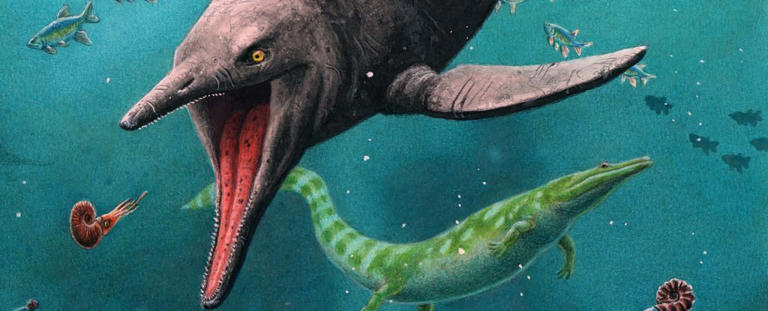
Dated to 250 million years ago, the remains represent the oldest evidence of ichthyosaurs we've ever seen. Moreover, the species represented by the bones was already large and well-adapted to marine life – at a time before the ichthyosaur form was thought to have emerged into the world.
This suggests that our timeline for ichthyosaurs might need to be reconsidered. They may have appeared prior to the End-Permian Mass Extinction that took place 251.9 million years ago, rather than evolving as a result of the event as has been suggested.
Oldest Ichthyosaur Known to Science Discovered on Remote Arctic Island

Tuesday, March 28, 2023
The Drift
Welcome to today's issue of Carolina Naturally

'Nuff Said!
Today is March 28, 2023

Today is: Barnum and Bailey Day


In 1910CE: 1st seaplane to take off from water under its own power is piloted by Henri Fabre from the Étang de Berre lagoon at Martigues, France

Ain't That The Truth
Editorial Comment

March has been a busy time here and this blog has reflected that with several gaps in postings. April might be better - but no guarantees. We still have some time left in March though.
We do want to give a shout out to our readers in Canada and Germany and say thanks for stopping by to read Carolina Naturally.
Remember to have fun and enjoy life.
Editorial Staff
Just Because You Don’t Use a Bidet Doesn’t Mean Your Butt Is Covered in Poop

Look, I’m not anti-bidet. I have one at home and I appreciate it. But there are some nonsensical bidet related myths going around that need to be flushed away. Chief among them: the idea that if you don’t use a bidet, you are walking around with a poop-encrusted butthole.
This is a myth often repeated by bidet users—either lifelong, or new converts who won’t shut up about it—and it makes no sense. Discussions about the pros and cons of different butt-cleaning methods often read like this Reddit thread, in which people who don’t know how bidets work talk past people who don’t know how toilet paper works. Folks, people the world over clean their butts via a variety of different methods that all work just fine.
Just Because You Don’t Use a Bidet Doesn’t Mean Your Butt Is Covered in poop
It's time to change the rules of the banking game

What the authorities did over the weekend was absolutely profound. They guaranteed the deposits, all of them, at Silicon Valley Bank. What that really means… is that they have guaranteed the entire deposit base of the U.S. financial system. The entire deposit base. Why? Because you can't guarantee all the deposits in Silicon Valley Bank and then the next day say to the depositors, say, at First Republic, sorry, yours aren't guaranteed. Of course they are.… So, this is a breathtaking step which effectively nationalizes or federalizes the deposit base of the U.S. financial system.
It's time to change the rules of the banking game
.jpeg)
These Bacon-Wrapped Banana Bites Are Self Care

Bacon makes everything better. I’m certainly not the first to say it, but that salty, smoky, meat strip is hard to resist. It seems, however, that bacon has met its match. The banana, and its cousins, make everything better too. Luckily for us, they’re not enemies. In fact, when combined, they make the best snack I’ve had all week. Air fried bacon-wrapped banana bites contain a symphony of complementary flavors, and I would absolutely serve them at any party.
I have a bizarre mind for flavor combinations, but before this, I never would have taken banana and bacon seriously as a couple, until I was at a wedding in Brazil and tasted a small cup of sweet plantain purée with shredded, dried meat. It may have been beef. It may have been pork. I may have had several caipirinhas. I helped myself to three (hors d’oeuvre-sized portions), because everyone else was sleeping on this amazing concoction. On paper, I was confused by the pairing, but to my tastebuds, nothing could be more clear. The little bite was a whirlwind of sweet, earthy, creamy fruit purée with chewy, salty, smoky meat ribbons.
These Bacon-Wrapped Banana Bites Are Self Care
MIT Tackles the Best Way to Eat an Oreo Cookie

Owens aimed to discover if there is any way to twist open an Oreo and achieve creme sticking to both wafers. You are shaking your head no. At least now it's been scientifically proven. Owens and her team used a rheometer, a device that twists cookies open, to test different twisting speeds and different cookie flavors. This involved gluing the cookies to the rheometer's discs, which takes some of the magic out of the experiment. They tested more than 1,000 cookies, both by machine and with hand techniques. The results showed that 80% of the time, the cookies ended up with all the creme on one wafer, no matter how slowly the cookie was twisted or what method was used.
The researchers suggested that Oreo might turn the wafers over so that the printed side could grab the creme. That's not going to happen, because that's branding. It is evident that the creme is more cohesive than adhesive. If you want to eat an Oreo and have a consistent ratio of creme-to-wafer, you can always bite them like you would another kind of cookie.

The State of Sex Education in the USA in 2023

Simply put, America is failing its youth when it comes to sex education that actually answers their questions and equips them with knowledge that will protect their sexual health. This is part of the reason why the United States has much higher rates of teen pregnancy and STIs than other industrialized countries.
The State of Sex Education in the USA in 2023
Afghan girls struggle with poor internet as they turn to online classes

But when the teacher calls on Sofia to read a passage her computer screen freezes.
"Can you hear me?" she asks repeatedly, checking her connection.
After a while, her computer stutters back to life.
"As usual," a fellow student equally frustrated with the poor communications sighs as the class gets going again.
Sofia, 22, is one of a growing stream of Afghan girls and women going online as a last resort to get around the Taliban administration's restrictions on studying and working.
Taliban officials, citing what they call problems including issues related to Islamic dress, have closed girls' highschools, barred their access to universities and stopped most women from working at non-governmental organizations.
Afghan girls struggle with poor internet as they turn to online classes
The notebooks of the scientist who inspired Mary Shelley’s Frankenstein

In the first few years of the 19th century, there was no hotter spectacle in London than Davy’s lectures at the Royal Institution. The carriage traffic jams caused by his keen audience led to the introduction of London’s first one-way street.
Hundreds of members of the public, many of them women, crowded into the lecture theatre to hear the charismatic Davy speak about his cutting edge research. They would watch demonstrations of his work, which often included elaborate explosions and other breathtaking displays.
Why thousands of volunteers are transcribing the notebooks of the scientist who inspired Mary Shelley’s Frankenstein
Semordnilaps

Optical Illusion At Theresianum Academy

The photo of a gothic-looking gate was taken in a school in Vienna, Austria. It appears to extend much farther down the path, even though it’s actually smaller than how we might perceive it to be. This mind-bending gate leads to the Theresianum Academy, a private boarding and day school founded in 1746 by Empress Maria Theresa of Austria.
Thanks to an optical illusion, the gate provides a good lesson in perspective for the students of the institution. It shows that only one point is needed to trick our eye into thinking that something is either larger or further away than it is.

Navigators From The Marshall Islands Used Wave Charts To Guide Their Way
 For the untrained eye, the sea only looks like a featureless expanse of water. But for master navigators of Oceania, the sea is full of signs and clues that could help them reach their destination — from driftwood, birds, and even the direction of the waves.
Navigators from the Marshall Islands use wave charts to travel through the small islands and atolls in the region. These charts, which capture the distinctive patterns of ocean swells, are a result of constant observation of the sea from land. But as these are not maps, they are not brought to sea. Instead, the sailors memorize these stick charts.
Wave charts have three types: the rebbelib, which show whole island chains; meddo, which represent ocean swell patterns in small areas; and mattang, which teach basic interactions between land and sea.
The wave charts have been a crucial element in making the Pacific Ocean trade routes possible. These routes stretched "at some points all the way from New Zealand to South America." Now that's bonkers!

Navigators from the Marshall Islands use wave charts to travel through the small islands and atolls in the region. These charts, which capture the distinctive patterns of ocean swells, are a result of constant observation of the sea from land. But as these are not maps, they are not brought to sea. Instead, the sailors memorize these stick charts.
Wave charts have three types: the rebbelib, which show whole island chains; meddo, which represent ocean swell patterns in small areas; and mattang, which teach basic interactions between land and sea.
The wave charts have been a crucial element in making the Pacific Ocean trade routes possible. These routes stretched "at some points all the way from New Zealand to South America." Now that's bonkers!
The Baffling Case of Honeycomb Patterns in Salt Deserts May Have Been Finally Solved

The secret of the phenomenon lies beneath the dry crust. The process involves constant evaporation and turnover of salty and freshwater. This explains the regularity of the honeycomb-like patterns of the ridges. This property also seems to be present in all deserts.
While the study does not have an immediate application in the world, Jana Lasser, the physicist who led the study, says that she feels accomplished. She describes the study as "the purest form of research" and a "very, very satisfying experience."
.jpeg)
Subscribe to:
Posts (Atom)
The Drift
Welcome to today's issue of Carolina Naturally 'Nuff Said! Today is June 21, 2023 Today is: World Music Day On This Day In History...

-
 If you're not an angler, you might be surprised to see this kind of gruesome sign near fishing piers. When this one was posted at Reddi...
 -
 Want to try something new for retirement? Have you thought about retirement nudist communities? Retirement affords us the time to try new th...
 -
 Rainforests are dense forests in tropical regions inhabited by a variety of unusual species you won't find anywhere else on the planet. ...