Wednesday, April 5, 2023

The Drift

Welcome to today's issue of Carolina Naturally
'Nuff Said!
Today is April 5, 2023
Today is: National Walk Day
On This Day In History
In 1722CE: Dutch navigator Jacob Roggeveen is the first European to discover Easter Island / Rapa Nui in the southeastern Pacific.
Ain't That The Truth
Oh, and while you're at it - check out our sister blog Come What May for off the cuff and off the wall seriousness. Heck, who are we kidding, it's just fun and hilarity.

Editorial Comment

April is a continuation of March thus far... only warmer.

We do want to give a shout out to our readers in Canada and China and say thanks for stopping by to read Carolina Naturally.

Remember to have fun and enjoy life.

Editorial Staff

Sloop Johm B ...

Shameless Rules That Have Drastically Bettered My Life

“If you hesitate to learn from others, you will never learn anything new.”
― Raaz Ojha
Three years ago, I sat in a grey cubicle with coworkers whose facial expressions showed the same mixture of boredom, fatigue, and agony as mine.
Today, I woke up to chirping birds and chuckling geckos, watching the sun rise over lush green trees. I’m excited about my work, a midday stroll on the beach, and a colorful dinner prepared by my favorite chef. I live in the paradise others go to for vacation — and there’s no boss telling me when to be back.
This isn’t a metaphorical dick-measuring contest. I’m not saying look how big mine is. I’m merely showing you what’s possible if you play by the right rules instead of the ones imposed on you.
7 Shameless Rules That Have Drastically Bettered My Life


Deep Questions To Help You Figure Out What To Do With Your Life

If you're asking yourself, "What should I do with my life?" then you might be wondering how to change your life completely — but don't know where to start.
Maybe something is not right, maybe even downright toxic in your life. And you’re finally going to do something about it.
Or maybe you just know deep inside that it’s time to make a decision to “park it or drive it." To stay where you are or get moving in a new direction.
In order to figure out how to turn your life around, read on to find some deep questions to ask yourself. Your answers just might shine a light on the best path forward.
9 Deep Questions To Help You Figure Out What To Do With Your Life

Back Off ...

Dealing with people who push your buttons can be challenging, but there are effective ways to handle these situations. Here are 15 strategies to help you outsmart those who trigger you.
Back Off: 15 Easy Ways to Outsmart People Who Annoy You

Signs You're A Really Angry Person

It’s true that 
some people are angrier than others — stuck in an emotional gear that negatively impacts so many areas of life. At the farthest end of the angry spectrum, picture someone like the character Jack Nicholson plays in The Shining. Let’s all agree that this was one angry man.
While the vast majority of men and women don’t reach that ridiculous level of anger, scores of them still deal with the major signs of anger issues and have a powerful angry streak that colors their experiences every single day. Most of all, it’s one’s work and romantic life that suffer the most when one suffers from chronic anger.
However, a person’s anger can be seen in every aspect of his or her life. If you want to know how to deal with anger, take a look at the behaviors below and ask yourself if you show any of the warning signs.
5 Signs You're A Really Angry Person

Wake up little Suzy ...

Beethoven Probably Died From Liver Disease According To This Recent DNA Study

There had been previous attempts to extract genetic material from Beethoven's skull fragments in the past but to no avail. But thanks to modern advancements in DNA sequencing, we now have a better understanding of the composer's cause of death. A recent study suggested that the composer died from liver disease caused by several factors. Found in his DNA are two copies of a gene called PNPLA3, which is linked to liver cirrhosis. Also found are two variants of the HFE gene, which is a gene that can cause hereditary haemochromatosis. Finally, traces of Hepatitis B virus were found in his DNA. It also didn't help that Beethoven became a heavy drinker, especially in the year before his eventual demise.
Historical accounts of the composer's death seem to strengthen the findings from the recent DNA analysis. It is said that he developed jaundice, and his limbs swelled months before he passed away. Both conditions are telling signs of liver failure.
The loss of Beethoven's hearing remains a mystery, however. Perhaps a mystery that will probably be solved sometime in the future.

Colonoscopy Reveals a Ladybug

When I try to start conversations with strangers, one of my go-to questions is "What's the most surprising thing you've ever encountered in a colonoscopy?"
It doesn't have to be the person's own colonoscopy--just one that the person has experienced.
This gentleman (that's a man in the photo) had ladybug in his colon. A 2019 article in the medical journal American College of Gastroenterology Reports briefly describes the surprising appearance of a harmonia axyridis, one of 6,000 ladybug species in the world. If I understand the article correctly, the doctors assume that the patient swallowed the bug. His consumption of a full gallon of polyethylene glycol as part of the colonoscopy preparation may have protected the ladybug from digestion. 

When Animal Blood was Transfused Into Humans

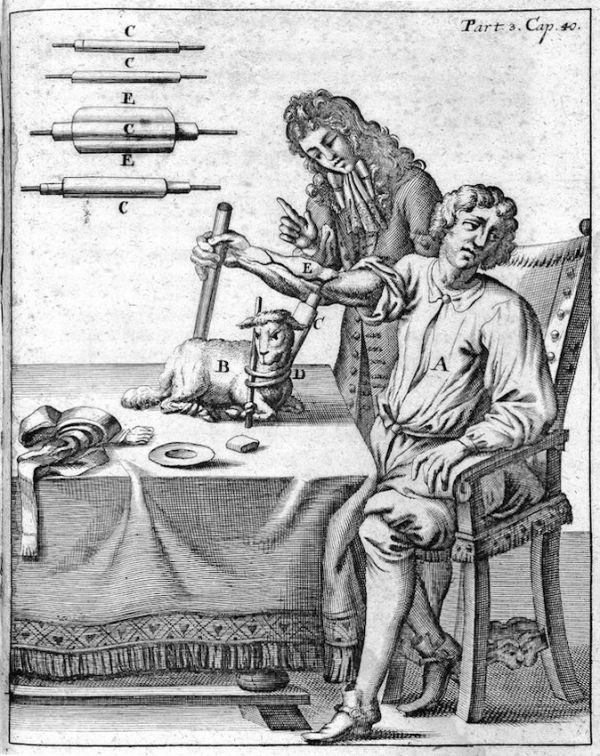
Back in 1667, medicine and philosophy were dangerously entwined. What physicians of the time 
didn't know about the human body was important- some organizations did not yet accept the theory of blood circulation. But French physician Jean Denis did, and after increasingly successful experimental blood transfusions between animals, he began giving the blood of lambs and goats to human patients. He figured that the blood of animals was cleaner and purer because they didn't drink alcohol and were free from sin.
Denis' first patient improved greatly, which may have been because he had already undergone many sessions of bloodletting and desperately needed the volume. His second transfusion patient was already healthy, but displayed renewed vigor. The third patient died. These transfusions sent the medical establishment into a frenzy. Things came to a head when he was sued over the death of his fifth patient in Paris, which ultimately turned out to be a murder. But that was the end of animal-to-human blood transfusions.
Denis was opposed to human-to-human blood transfusions because he assumed that the donor would not survive, which tells us something about how donor animals fared during his "successful" experiments. Read about Jean Denis' xenotransfusions and how they were received at The Public Domain review. 

A Less Biased Approach to Animal Behavioral Studies Might Be Key To More Insightful Findings

Animals are individuals. And because they are individuals, they also have personalities distinct from one another. Some animals are reckless, and others are shy.
Similar to how our personality affects the way we function and perform in daily life, the innate personality of an animal also affects its performance in an experiment.
If this is truly the case, does this imply that the findings from numerous animal behavioral studies are inaccurate and biased? For many scientists in the field, the answer is yes. Christian Rutz realized this problem years ago when he conducted a study on New Caledonian crows. Knowing this problem, how can we solve it?
Rutz and his colleague Michael Webster suggest this new framework in animal behavioral research: the STRANGE approach.
STRANGE is an acronym for factors that behavioral researchers should consider when they conduct studies. These factors are:
  • Social background
  • Trappability and self-selection
  • Rearing history
  • Acclimation
  • Natural changes in responsiveness
  • Genetic makeup, and
  • Experience
While Rutz acknowledges that removing all biases in a study could be impossible, he still encourages his fellow researchers to ponder how these factors affect their studies. He also calls on them to be transparent with these said factors. In this way, the findings of animal behavioral studies can be more meaningful and reliable.

Subcontinent solo ...

Stressed Plants Emit Airborne Sounds That Can Be Detected From Over A Meter Away

What does a stressed plant sound like? A bit like bubble-wrap being popped. Researchers in Israel report in the journal 
Cell on March 30 that tomato and tobacco plants that are stressed—from dehydration or having their stems severed—emit sounds that are comparable in volume to normal human conversation. The frequency of these noises is too high for our ears to detect, but they can probably be heard by insects, other mammals, and possibly other plants.
“Even in a quiet field, there are actually sounds that we don’t hear, and those sounds carry information,” says senior author Lilach Hadany, an evolutionary biologist and theoretician at Tel Aviv University. “There are animals that can hear these sounds, so there is the possibility that a lot of acoustic interaction is occurring.”
 Although ultrasonic vibrations have been recorded from plants before, this is the first evidence that they are airborne, a fact that makes them more relevant for other organisms in the environment. “Plants interact with insects and other animals all the time, and many of these organisms use sound for communication, so it would be very suboptimal for plants to not use sound at all,” says Hadany.
The researchers used microphones to record healthy and stressed tomato and tobacco plants, first in a soundproofed acoustic chamber and then in a noisier greenhouse environment. They stressed the plants via two methods: by not watering them for several days and by cutting their stems. After recording the plants, the researchers trained a machine-learning algorithm to differentiate between unstressed plants, thirsty plants, and cut plants.
Stressed Plants Emit Airborne Sounds That Can Be Detected From Over A Meter Away

Researchers are discovering ‘zombie forests’ in new places across the western U.S

It’s no secret that our warming atmosphere has resulted in 
extreme weather all over the world, but there’s also a less noticeable consequence at work as well. Rising ambient temperatures mean that thousands of coniferous forests in California will be unable to replenish their numbers once they die.
Researchers are discovering ‘zombie forests’ in new places across the western U.S. — here’s what makes that so concerning

Lady in red ...

What Antarctica Looks Like Under All That Ice

You may know that the South Pole sits on solid land and the North Pole is but a spot in the Arctic Ocean, but it’s probably difficult to imagine either pole as anything but a giant sheet of ice.
But if you've ever wondered what the land underneath Antarctica’s ice—the largest ice sheet on Earth—actually looks like, NASA and the British Antarctic Survey have the answer. Using satellite imagery, sensor records, and data collected by NASA’s Operation IceBridge, which surveys the world’s polar zones by air, the British researchers compiled a stunning map of the southern continent without its frozen mantle [PDF].
The image, dubbed Bedmap2, gives scientists a clear picture of Antarctica's ice-free geology. It also reveals new topographical superlatives. According to a statement from the British Antarctic Survey, the continent’s new deepest point, located beneath Byrd Glacier, is an astounding 9416 feet (2870 meters) below sea level, about 1300 feet (400 meters) deeper than the previous record. It’s also the lowest point ever found on any of the planet's continental plates.
“Before, we had a regional overview of the topography,” Peter Fretwell, a cartographer at the British Antarctic Survey, said in the statement. “But this new map, with its much higher resolution, shows the landscape itselfa complex landscape of mountains, hills and rolling plains, dissected by valleys troughs and deep gorges.”
What Antarctica Looks Like Under All That Ice

How Seismology Helped Us See Inside Stars

How do we know how hot our Sun is? How do we know the internal structure of stars and the type of fusion processes occurring inside them, despite not taking a single step into them? Believe it or not, the answer is seismology, the study of earthquakes.
The story begins with the development of the seismograph, which allowed us to record ground oscillations. With the power of science and mathematics, these oscillations became the key to mapping our planet's interior.
Fast forward to the 1960s, the decade of powerful telescopes. These tools not only allowed us to zoom in on the heavenly bodies, but they also allowed us to see them in finer detail. And with this advancement, scientists realized that the Sun oscillated, too. This gave them the revelation that the methods of seismology might also apply to our Sun. This gave birth to helioseismology. And if seismology applies to our Sun, then it would also work for other stars out there. This realization gave rise to asteroseismology.
Big Think tells more details about this fascinating story.

Solar system hit by the most powerful explosion in the universe

The solar system might have been hit by the brightest explosion ever seen, scientists have said.
The intensity of the blast was such that researchers were unable to properly study it, since it blinded the instruments that would usually be used to measure its intensity.
The pulse of intense radiation began its life in a cosmic explosion two billion light years away from us. Since then, it has been smashing through the universe, reaching our solar system in October last year.
Solar system hit by the most powerful explosion in the universe

Astronomers Just Found a Half-Million Light Year Long Stream in the Early Universe

Astronomers have been looking for the source of the matter that makes up 
early galaxies for decades. Now, for the first time, astronomers have observed the cold, steady streams of gas that make up the raw material for stars.
Despite the name, the filamentary stream surrounding and heading into the galaxy 4C 41.17— more than 10 billion light years away — is immense: a thin stream of cold carbon gas 100 kiloparsecs, or half a million light years, wide, and as massive as 140 billion suns. That’s the results found in paper published this week in Science, which resulted from an unusual use of a radio telescope.
Astronomers Just Found a Half-Million Light Year Long Stream in the Early Universe

Splendor in the grass ...

Massive Dinosaurs Grew Their Sizes In Two Different Ways

Paleontologist Michael D'Emic found something interesting when he cut the bones of the Majungasaurus. He found that the dinosaur that measured up to 7 meters high grew "really, really slowly." The prevalent idea amongst paleontologists was that big dinosaurs became big through rapid growth spurts, so what D'emic found through his investigation was rather surprising, which prompted him to look further into other dinosaur bones to see if there are different growth strategies in them. What followed was a decade-long study, and with the time that passed came new knowledge of the distant past. As it turns out, the strategy of carnivorous dinosaurs to get big fast was less predominant than what paleontologists previously assumed.
Understanding an animal's growth strategy may seem trivial at first, but it is essential in understanding a creature's life and environment. Did the animal grow in a competitive environment? Was it a hot environment or a cold one?
Growth strategy also has a correlation to an animal's lifespan and number of offspring.
More about this over at Quanta Magazine.

Boy finds 200-million-year-old fossil on Welsh beach

A 9-year-old boy has found a fossil from the Jurassic period on a beach in South Wales.
Eli found the 200-million-year-old artifact while out with his family at Llantwit Major beach in Vale of Glamorgan, reports BBC .
While the area is well-known for its fossils, the ammonite, a type of mollusk, is an unusually large find with a 0.3-metre diameter and is well-preserved.
Boy finds 200-million-year-old fossil on Welsh beach

Scientists Find Footprints Older Than the Dinosaurs

A mat composed of microbes may have preserved a series of 255-million-year-old indentations made in a sandy South African tidal bottom by a hulking amphibian, 
a new study says.
The remarkable shapes reveal that the nearly 2-meter-long rhinesuchid temnospondyl lurked for its prey and swam after it in the fashion of a crocodile. Like a prehistoric choreographer’s diagram, the impressions are a unique window into life on ancient earth shortly before the Permian Mass Extinction Event destroyed 90 percent of species on the planet.
“The findings of the study are significant because they help to fill in gaps in our knowledge of these ancient animals,” the authors say in a statement. “The remarkable tracks and traces […] provide direct evidence of how these animals moved and interacted with their environment.”
Scientists Find Footprints Older Than the Dinosaurs

Animal Pictures

The Drift

Welcome to today's issue of Carolina Naturally 'Nuff Said! Today is June 21, 2023 Today is:   World Music Day On This Day In History...