
Friday, February 3, 2023

Thursday, February 2, 2023
The Daily Drift
Welcome to today's issue of Carolina Naturally
.jpeg)
'Nuff Said!
Today is February 2, 2023

Today is: Imbolc


In 1653CE: New Amsterdam becomes a city (later renamed New York)

Ain't That The Truth
Editorial Comment

Another liquid sunshine filled day! Joy.
We do want to give a shout out to our readers in Indonesia and Thailand and say thanks for stopping by to read Carolina Naturally.
Remember to have fun and enjoy life.
Editorial Staff

Could You Pass The U.S. Citizenship Test?

Could You Pass The U.S. Citizenship Test?
Why You May Have Trouble Recalling Events of the Past Three Years
.jpeg)
Speculation from brain researchers tells us that two factors will do this: monotony and stress. Many people went home and stayed there, working online, taking classes from home, or supervising children 24/7 (or all three). Long-term memories are formed by the outlines of how different an event is from life around it. When every day is the same, it's difficult to form new memories. Then there was the stress of lifestyle changes, new safety protocols, social upheavals, and fear of the disease. This reminds me of what's colloquially known as "mommy brain" or "widow brain," in which focusing on new priorities makes previously-important parts of your life fade into oblivion.
Read about the factors that may contribute to the impairment of making new memories during the pandemic, whether it's just inconsequential forgetting or full-blown brain fog, at the Walrus.
Why You May Have Trouble Recalling Events of the Past Three Years
This one behavior can help you resist cheating on your partner, according to science

This one behavior can help you resist cheating on your partner, according to science.

When to Take the Money in a Class-Action Settlement (and When Not To)

The class actin settlement du jour is from the Thinx period underwear company, having to do with allegations that the menstrual products contain harmful chemicals that potentially cause fertility issues or cancer. While Thinx denies these allegations, they are providing the following options for people who submit a claim before mid-April: take a cash reimbursement for $7 per pair for up to three pairs; get 35% off a single purchase up to $150; object; exclude yourself from the settlement; or do nothing.
Thinx is not the only settlement available right now, and each one offers different options and caveats. So, how do decide when a settlement is a good deal—or when you should hold out in case you want to bring action later?
When to Take the Money in a Class-Action Settlement (and When Not To)
Your Odds of Dying by Accident

Can an unborn fetus be a state employee?
"Lawyers representing the Missouri Department of Transportation want you to believe an unborn baby was working for the state during a fatal work zone crash, all in order to have a lawsuit dismissed.
The bizarre opinion is in response to a lawsuit over the November 2021 tragedy that killed two MoDOT employees, one of whom was pregnant.
 “First of all, it’s illogical. How would somebody who hasn’t even been born yet work for you?” he said. “But if they were to get someone to buy that, then that means your case is dismissed out of St. Louis County, go to the comp system, where they’re going to take a different position, just like they did initially.”
Workers’ comp already denied Anderson’s family claim because Kaitlyn was not married and had no dependents. Mundwiller says workers’ comp will certainly deny an unborn baby.
“What they’re hoping is they don’t pay anything,” he said.
MoDOT did not have a protective truck in place that day, even though it’s a department policy. That’s the focus of a lawsuit that, Kaitlyn’s mom says, MoDOT keeps avoiding."
The bizarre opinion is in response to a lawsuit over the November 2021 tragedy that killed two MoDOT employees, one of whom was pregnant.

Workers’ comp already denied Anderson’s family claim because Kaitlyn was not married and had no dependents. Mundwiller says workers’ comp will certainly deny an unborn baby.
“What they’re hoping is they don’t pay anything,” he said.
MoDOT did not have a protective truck in place that day, even though it’s a department policy. That’s the focus of a lawsuit that, Kaitlyn’s mom says, MoDOT keeps avoiding."
Medicare Advantage plans took millions from the US government and aren't required to pay it back

"Medicare Advantage plans for seniors have dodged a major financial hit as federal officials decided to give them a reprieve on returning hundreds of millions of dollars or more in government overpayments — some dating back a decade or more," the report reads.
Medicare Advantage plans took millions from the US government and aren't required to pay it back

How to be a profitable company

The company, along with CSX, Norfolk Southern and Burlington Northern Sante Fe, narrowly avoided a strike by its unionized workers when Congress imposed new contracts on about half of its union members in December.
For the year, the company’s employee pay and benefits rose by about $500 million, or 12%, to $4.6 billion, far less than the $6.3 billion that Union Pacific spent repurchasing shares of stock. "
'We will figure out how to fire you'

In 1950, one in three Americans was unionized; in 2022, it was roughly one in ten. And that 2022 number falls even lower when public-sector workers are excluded; among private-sector workers, according to the BLS, the U.S. had only a 6 percent unionization rate in 2022.
Yet employees of some major corporations, including Starbucks, Apple Stores, Chipotle and Trader Joe’s, have been trying to unionize. And according to The Guardian’s Michael Sainato, some of them fear retaliation from management.
'We will figure out how to fire you': Report shows how major corporations are fighting unionization.
What personality types do best in hybrid work?

Such seemingly random differences frustrate and confuse managers. No wonder that Microsoft research found that “85% of leaders say that the shift to hybrid work has made it challenging to have confidence that employees are being productive.”
What personality types do best in hybrid work?
Why people risk their lives to make millions of bangles in India

- Glass bangles are popular accessories for millions of women in India.
- Making them exposes workers to scorching hot furnaces, broken glass, and dangerous fumes — all for less than $10 a day.
- We went inside a bangle factory in Firozabad, India, to see how these vibrant bracelets are made.
Read the original article on Insider

‘Ghost Ship’ Discovery in the Bermuda Triangle Might Solve a 76-Year-Old Mystery

Others believe that the Triangle is a portal to another dimension and that the missing ships and planes have been transported to another realm. But, despite the many theories, no one has been able to explain the mysteries of the Bermuda Triangle definitively.
‘Ghost Ship’ Discovery in the Bermuda Triangle Might Solve a 76-Year-Old Mystery
European Farms Mix Things Up To Guard Against Food-Supply Shocks

By ETHAN BILBY
‘Items in this section have limited availability due to supplier production issues,’ ‘Sorry, temporarily out of stock’ and ‘Sold out’ are all signs that became familiar as recent global upheavals exposed how precarious our food supply is.
The COVID-19 pandemic led to bare shelves in supermarkets as shipping routes were cut off. The war in Ukraine has affected the supply of essential grains.
But increased climate change stands to cause even greater disruption. Researchers say part of the solution to mitigating that risk is for farms to become more mixed through some combination of crop cultivation, livestock production and forestry, a move that would also make agriculture more sustainable.
For Dr Sara Burbi, assistant professor at Coventry University in the UK until December 2022 and now an independent researcher, COVID-19 was a wake-up call.
‘Suddenly, we experienced first-hand what happens when value chains are not resilient to shocks and what happens when globalisation, with all its intricacies, does not work anymore,’ she said. ‘We saw highly specialised farming systems fail when they over-relied on external inputs that they had no access to.’
Climate change, according to Burbi, could provide even bigger global shocks ranging from widespread crop failures to lower yields or damage from flooding. More sustainable agriculture is essential to ensure food supplies can withstand the impact of climate change and unexpected local, national and even global crises.
Beneficial combos
During her tenure at Coventry University, Burbi coordinated the EU-funded AGROMIX project, which runs until end-October 2024.
As part of the project, pilot farms across Europe are experimenting with combining crop and livestock production in one farm (mixed farming) and with pairing farming and forestry activities (agroforestry). Poultry grazing in orchards is an example of a mixed-farming approach. The results reveal interesting synergies and promising effects, including improvements in soil health.
‘For a long time, forestry and agricultural activities have been considered at odds, as we have pushed for more and more specialised land uses,’ Burbi said. ‘This has led to loss of soil fertility and a sharp decline in biodiversity, coupled with an increased dependence on external inputs to compensate.’
A combined system can increase the cycling of nutrients needed in the soil for crops to grow. It can also help to regulate air and water quality, prevent land degradation and even provide biomass and food on-site for livestock.
One site in Switzerland, for instance, found that mixed farming helped keep soil quality high, while more specialised farming tended to deplete it.
AGROMIX will use 12 pilot sites and nine experimental ones, spread across three climatic zones (Atlantic, Continental and Mediterranean), to develop recommendations for farmers on combining productivity with greater sustainability and climate resilience.
Although mixed farming has been practiced for a long time, it is only recently that scientists have begun to measure biophysical data on such sites and provide real evidence to support approaches that work.
The project has found that the presence of trees on pasture has measurable benefits to animal health and welfare, especially in extreme heat when they provide a canopy of much-needed shade.
Trees and hedgerows can also offset greenhouse-gas emissions from livestock, increase the carbon sequestration capacity of the land, provide a haven for biodiversity and help prevent flooding.
The project wants to work closely with farmers, taking into account their needs and priorities.
‘Knowledge integration can empower key actors, in this case farmers, to embrace the transition to sustainable farming,’ Burbi said.
The next step will be designing agriculture systems that are totally energy independent and, as a result, even more sustainable.
Forest focus
The EU-funded MIXED project at Aarhus University in Denmark is also focused on combining mixed farming systems with agroforestry to make agriculture more efficient and resilient.
‘It’s not only about economic efficiency, but also environmental and climate efficiency,’ said Professor Tommy Dalgaard, the project coordinator. ‘Agriculture needs to be resilient to change, all kinds of change.’
Working with around 100 farmers across Europe, MIXED has created networks to study the different ways in which mixed farming and agroforestry can be used.
One focus is on the take-aways that can be gleaned from the traditional agroforestry techniques used in the Tagus Valley of Portugal, in an area known as the Montado.
‘They have these big cork oaks that are often more than 100 years old with grazing cattle below them,’ said Dalgaard. ‘In the winter, they can plough the soil and make small fields with cereal so they can harvest a winter crop and then in the dry season the cattle can be there.’
It is possible to have these green, vegetated areas because of the ancient oak trees, which create shade and sustain the water cycle.
The concern is that drought may threaten the oaks, so researchers from the project are trying to work out how best to preserve the system as well as how to adapt it to new areas.
Danish farms in the project have taken a different approach, looking at how farmers can use coppicing to create a carbon sink. Coppicing is a pruning technique that cuts trees to ground level, causing new shoots to grow rapidly from the base to form a bush.
These are then usually harvested every 10-20 years for biomass fuel, meanwhile also giving shelter and shadow to free-range, high-value livestock such as sows with piglets. Cutting the bushes to create mulch also helps to improve soil quality and avoids burning them, according to Dalgaard.
The project’s ultimate aim is to build up a European database demonstrating examples of mixed farming and agroforestry, highlighting the benefits and advising on best practices. Essentially, it is about inspiring more farmers to adopt mixed farming and agroforestry methods and supporting them in the process.
‘We need real-life examples,’ said Dalgaard. ‘We now have some concrete examples of farmers, agricultural landscapes and value chains that can report good results from having done something in a different way.’
More info
Nuclear fusion won't save the climate. But it might blow up the world

Nuclear fusion won't save the climate. But it might blow up the world

Physicist Reveals What the Fourth Dimension Looks Like

- Theoretical physicists believe math shows the possibilities of a fourth dimension, but there’s no actual evidence—yet.
- Albert Einstein believed space and time made up a fourth dimension.
- An example from a string theorist gives a view of what a fourth dimension could be.
But in a new video from Big Think, Brian Greene, a string theorist from Columbia University, offers up a relatively simple explanation of just what a fourth dimension could entail—and where it could be.
Physicist Reveals What the Fourth Dimension Looks Like
A Bizarre Study Says People Can Live in Asteroids. It's Actually a Brilliant Idea.
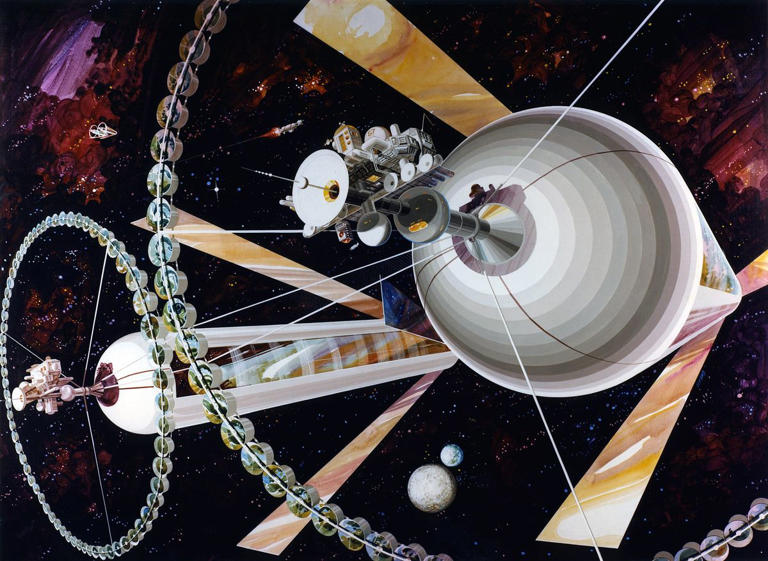
These O’Neill cylinders, which were subsequently detailed extensively in the physicist’s 1976 book High Frontiers, have captivated scientists and futurists for half a century. In 2019, Jeff Bezos gave an entire presentation divulging his desire to build O’Neill cylinders, and the idea is on full display in shows like Babylon 5, novels like Arthur C. Clark’s Rama, and films like Interstellar.
The basic concept of a O’Neill cylinder is that a spinning tube-like structure simulates gravity via a centripetal force acting on humans living on the cylinder’s inner surface. Although the physics of such a structure checks out, actually building one would likely be the most gargantuan megaproject in human history—but scientists from Rochester University think transforming asteroids into O’Neill cylinders might be the best strategy.
In a study published last year, scientists examined near-Earth asteroids, such as Bennu (the object of the OSIRIS-REx mission), as potential candidates for O’Neill cylinders. Asteroids are particularly attractive candidates because the building materials are already in space (ferrying materials from Earth would likely be prohibitively expensive) and they’d protect a colony from space radiation.
A Bizarre Study Says People Can Live in Asteroids. It's Actually a Brilliant Idea.
NASA Webb Telescope Zooms in on One of Solar System's Oddest Objects

Astronomers initially discovered the rings in 2013 while watching Chariklo occult, or pass in front of, a distant star. To their surprise, two other smaller objects also appeared to pass in front of the background star for an instant. These turned out to be two thin rings around Chariklo.
In October 2022, Pablo Santos-Sanz, from Instituto de Astrofísica de Andalucía in Spain, used Webb to watch Chariklo occult a star once again.
NASA Webb Telescope Zooms in on One of Solar System's Oddest Objects
Subscribe to:
Posts (Atom)
The Drift
Welcome to today's issue of Carolina Naturally 'Nuff Said! Today is June 21, 2023 Today is: World Music Day On This Day In History...

-
 If you're not an angler, you might be surprised to see this kind of gruesome sign near fishing piers. When this one was posted at Reddi...
 -
 Want to try something new for retirement? Have you thought about retirement nudist communities? Retirement affords us the time to try new th...
 -
 Rainforests are dense forests in tropical regions inhabited by a variety of unusual species you won't find anywhere else on the planet. ...