Thursday, January 26, 2023

New analysis raises questions about America's 'missing recession'

Since the COVID-19 pandemic, there have been 
looming concerns about the possibility of America falling into a deep recession. Over the past six months, those concerns have escalated. However, a new analysis argues that those financial predictions have fallen short.
New Statesman's Will Dunn began his analysis with a brief recap of concerns expressed by CEOs of some of the country's top corporations.
"In June last year Jamie Dimon, the chief executive of JP Morgan, America’s (and the world’s) largest bank, warned that an economic 'hurricane' was 'right out there, down the road, coming our way,'" Dunn wrote, adding, "Other CEOs and analysts agreed; Elon Musk, who was at that point still considered a capable user of money, had a 'super bad feeling' about the US economy."
Despite the verbalized concerns, the country's economy and workforce have continued to thrive.
New analysis raises questions about America's 'missing recession'

Swarm

The Supreme Court's accelerating slide into illegitimacy

This weekend marked what would have been the 
50th anniversary of the U.S. Supreme Court’s Roe v. Wade decision granting the right to an abortion. The reversal of that decision in last year’s Dobbs v. Jackson Women’s Health Organization has had a massive ripple effect in the months since it was first leaked, then handed down, reverberations that serve to amplify the court’s existing legitimacy crisis.
The results of the 2022 midterm, for example, and the very obvious failure of a red wave to emerge. There’s also the plummeting trust in the institution and approval of it, a growing sense that it is both too ideological and tipped too far to the lunatic fringe.
The Supreme Court's accelerating slide into illegitimacy

What If a Conjoined Twin Commits a Crime?

If a conjoined twin were to commit a crime, what would be the legal implications? The state could certainly put the perpetrator on trial, but could they be punished with a prison sentence? One twin could not be incarcerated without the other, and that would mean jailing an innocent person. You might think, how could one be guilty without the other also being guilty? There are plenty of crimes that happen in the blink of an eye, like shoplifting or simple assault, that the second twin might have no knowledge of before the moment it happens. That brings up the question of how responsible one twin would be for preventing their sibling's crime, or failing to report, or even fleeing. While one twin might be the guilty party, the other might be an accessory to a crime. That brings up the question of free will, the exact nature of the twins' physical bond, and how competent each twin is.
This is a common thought experiment in law school but believe it or not there have been a couple of real-world cases, including one in the US. There was also a fictional case in the TV series American Horror Story. Read about those cases and the legal questions surrounding conjoined twins and the law

As California reels from its mass shootings, it's still safer than Missouri

Some might argue that the mass shooting that killed 11 people in California somehow proves gun restrictions don’t work. After all, California has the toughest gun-control laws in America. But even a cursory look at the data finds that tragedies like this are the exceptions that underscore the rule. California has among the lowest gun-death rates in the country, as do Illinois and other states with strong laws. Largely unregulated states like Missouri, meanwhile, consistently have among the highest death rates. What the California tragedy shows is that, in a nation with open state borders and the world’s biggest civilian stockpile of guns, only strong national gun restrictions can ultimately address this national crisis.
Read More

Spillway

Celebrating the Return of the Sun in Iceland

In Iceland, people are beginning to celebrate Sólardagur by enjoying sólarkaffi. That takes a bit of explanation. Iceland is below the Arctic Circle, but it is close and quite mountainous. In some valley communities, the sun does not shine for a month or so on either side of the winter solstice. Sólardagur translates to Sun Day, the day when the light comes back, even for just a few minutes. That calls for a celebration which involves sólarpönnukökur (sun pancakes) and sólarkaffi (sun coffee). Some villages, schools, and and workplaces have community breakfasts to celebrate, and children sing songs welcoming the sun.
In those villages affected by midwinter darkness, the coffee and pancake tradition goes way back. But due to people moving into the city, meaning Reykjavík, they spread the traditions of 
Sólardagur to all of Iceland. Read about the return of the sun to Iceland and the celebrations that accompany it at Atlas Obscura. 

Scientists may have come up with a way to study the smallest form of matter

Quarks are the smallest form of matter that we know of. So small, in fact, that studying it in any meaningful way has proven nearly impossible over the past several decades. That’s because quarks and their counterpart gluons are the small pieces of the puzzle that make up the nucleons in an atom. And the only way to see them is to split open atoms.
The problem, though, lies in the fact that these very small pieces of matter immediately form back together, making it nearly impossible to get any read on them in the first place. It’s something that has long held up the studying of the lowest form of matter we know of, and without studying these components, we’ll never properly understand how matter gets its mass.
But this problem could soon be a problem for the past, as scientists may have figured out a way to confine quarks, giving them a much better chance at understanding and studying them. The solution was created by a group of researchers from the University of Tokyo’s Department of Physics. The theory here is that most of the mass of a quark and a gluon is composed of an unknown force.
Physicists refer to this force as the “strong force.” It isn’t a very exciting name, to be sure, but they say that this force is responsible for holding the quarks and gluons together, essentially binding them so that they can form the nucleons that then go on to make up atoms. This idea is part of a theory called quantum chromodynamics (QCD).
If this is indeed true, then that means that studying this so-called strong force becomes more important than studying the quarks and gluons themselves, as it appears to hold more of the mass scientists are looking to understand. Unfortunately, rigorous proof of these forces holding these minute pieces of matter together isn’t easily available, which means studying it becomes difficult, too.
But scientists believe that mathematical equations they have come up with could help give us a way to study this force more in-depth, and that it could help us better understand quarks and gluons as a whole once they get things working. Understanding this could even help scientists in their pursuit to create matter. A study on the theory was published in the Physical Review Letters.

A New Model For Dark Matter

Dark matter remains one of the greatest mysteries of modern physics. It is clear that it must exist, because without dark matter, for example, the motion of galaxies cannot be explained. But it has never been possible to detect dark matter in an experiment.
Currently, there are many proposals for new experiments: They aim to detect dark matter directly via its scattering from the constituents of the atomic nuclei of a detection medium, i.e., protons and neutrons.
A team of researchers—Robert McGehee and Aaron Pierce of the University of Michigan and Gilly Elor of Johannes Gutenberg University of Mainz in Germany—has now proposed a new candidate for dark matter: HYPER, or “HighlY Interactive ParticlE Relics.”
In the HYPER model, some time after the formation of dark matter in the early universe, the strength of its interaction with normal matter increases abruptly—which on the one hand, makes it potentially detectable today and at the same time can explain the abundance of dark matter.
The new diversity in the dark matter sector
Since the search for heavy dark matter particles, or so-called WIMPS, has not yet led to success, the research community is looking for alternative dark matter particles, especially lighter ones. At the same time, one generically expects phase transitions in the dark sector—after all, there are several in the visible sector, the researchers say. But previous studies have tended to neglect them.
“There has not been a consistent dark matter model for the mass range that some planned experiments hope to access. “However, our HYPER model illustrates that a phase transition can actually help make the dark matter more easily detectable,” said Elor, a postdoctoral researcher in theoretical physics at JGU.
The challenge for a suitable model: If dark matter interacts too strongly with normal matter, its (precisely known) amount formed in the early universe would be too small, contradicting astrophysical observations. However, if it is produced in just the right amount, the interaction would conversely be too weak to detect dark matter in present-day experiments.
“Our central idea, which underlies the HYPER model, is that the interaction changes abruptly once—so we can have the best of both worlds: the right amount of dark matter and a large interaction so we might detect it,” McGehee said.
And this is how the researchers envision it: In particle physics, an interaction is usually mediated by a specific particle, a so-called mediator—and so is the interaction of dark matter with normal matter. Both the formation of dark matter and its detection function via this mediator, with the strength of the interaction depending on its mass: The larger the mass, the weaker the interaction.
The mediator must first be heavy enough so that the correct amount of dark matter is formed and later light enough so that dark matter is detectable at all. The solution: There was a phase transition after the formation of dark matter, during which the mass of the mediator suddenly decreased.
“Thus, on the one hand, the amount of dark matter is kept constant, and on the other hand, the interaction is boosted or strengthened in such a way that dark matter should be directly detectable,” Pierce said.
New model covers almost the full parameter range of planned experiments
“The HYPER model of dark matter is able to cover almost the entire range that the new experiments make accessible,” Elor said.
Specifically, the research team first considered the maximum cross section of the mediator-mediated interaction with the protons and neutrons of an atomic nucleus to be consistent with astrological observations and certain particle-physics decays. The next step was to consider whether there was a model for dark matter that exhibited this interaction.
“And here we came up with the idea of the phase transition,” McGehee said. “We then calculated the amount of dark matter that exists in the universe and then simulated the phase transition using our calculations.”
There are a great many constraints to consider, such as a constant amount of dark matter.
“Here, we have to systematically consider and include very many scenarios, for example, asking the question whether it is really certain that our mediator does not suddenly lead to the formation of new dark matter, which of course must not be,” Elor said. “But in the end, we were convinced that our HYPER model works.”
The research is published in the journal Physical Review Letters.

A New Model For Dark Matter

NASA, Pentagon developing nuclear-powered rocket for Mars voyage

NASA is partnering with a Pentagon research agency to develop a nuclear-powered rocket engine in preparation for sending astronauts to Mars.
NASA Administrator Bill Nelson said Tuesday that the US space agency will team up with the Defense Advanced Research Projects Agency (DARPA) to "develop and demonstrate advanced nuclear thermal propulsion technology as soon as 2027."
"With the help of this new technology, astronauts could journey to and from deep space faster than ever –- a major capability to prepare for crewed missions to Mars," Nelson said in a statement.
DARPA is the Pentagon's research and development arm and has played a role in many of the notable innovations of the 20th century including the internet.
NASA, Pentagon developing nuclear-powered rocket for Mars voyage

Owl Tea

A Tumor More Than 215 Million Years Old

Traces of diseases occasionally found in the bones of prehistoric animals are evidence of the ancient ancestry of some diseases, which sometimes lasted hundreds of millions of years.
Now, an interdisciplinary, international research team led by Dr. Dawid Surmik of the Faculty of Natural Sciences at Silesian University in Katowice, Poland, has produced another important piece of evidence for the occurrence of cancers in Earth’s distant past.
In an article published in the journal BMC Ecology and Evolution (in the special collection Evolutionary Biology and Ecology of Cancer), the scientists present the results of their study of a vertebra. It originates from the Upper Triassic and can be traced back to an extinct Temnospondyl amphibian: Metoposaurus krasiejowensis. The fossil was discovered in the famous Krasiejów locality located near Opole in southwestern Poland, known for numerous remains of fossil vertebrates.
Pathological tissue penetrated deep into the vertebra
The researchers noticed an overgrowing bone mass covering a large part of the vertebra, which belongs to the scientific collection of the Institute of Paleobiology of the Polish Academy of Sciences in Warsaw. Working with the University of Silesia’s Faculty Laboratory of Computational Microtomography, the researchers used X-rays to examine the internal structure of this fossil. The scans showed that the diseased tissue not only grew around the vertebra from the outside, but also penetrated deep into its interior.
“Based on this data, it became clear that the cause of the overgrowth was a malignant tumor,” Surmik says. Further analysis of the scans revealed that much of the vertebra’s original structure had been destroyed by the growth of cancerous pathological tissue. The researchers sectioned the sample and produced a thin, translucent sample that can be viewed in a transmitted light microscope – much like modern cancer samples are examined in medical laboratories.
Histological analyses at the University of Bonn
Paleontologists Sudipta Kalita, Elzbieta M. Teschner and Dr. Dorota Konietzko-Meier of the Institute of Geosciences at the University of Bonn performed the histological analyses and three-dimensional reconstruction of the vertebra. “These data helped us make a kind of `medical’ diagnosis,” Dr. Konietzko-Meier says. “We proved that the bone tissue took an atypical course and were able to describe the specific tumor development and reconstruct its ontogenetic growth dynamic, thus how the tumor grew during the animals’ life. This was the first time when the growth dynamic was described for an extinct animal”.

The dissected vertebral specimen revealed a lot of information about the histological structure of the pathological tissue, especially about the contact between the cancerous part and the healthy one. Based on these observations, the research team concluded that the cancer that had affected the fossil amphibian was osteosarcoma. It is among the most common malignant bone tumors in humans.
“This malignant tumor in Metoposaurus is currently one of the oldest examples of cancer in the fossil record and the only one associated with a fossil amphibian,” Surmik says. It is also the best-documented evidence of cancer in a prehistoric animal, he adds, supported by solid results from microstructural studies.

Rapid development is main threat to big carnivores

Declines in populations of big carnivores like lions, tigers and wolves may be driven more by rapid human economic development than habitat loss or climate change, according to a new study Tuesday.
The researchers hope the findings could help to improve policies for protecting carnivore populations, which have been driven to the brink of extinction in many parts of the world.
The study found that faster economic development was linked to a quicker decline in carnivore populations.
"In the midst of rapid development, people appear to become less tolerant of carnivores, conflicts explode, and we suspect that incidences of poaching and persecution rocket," lead author Thomas Johnson said in a press release.
Rapid development is main threat to big carnivores: study

Young Chimps, Human Teens Share Risk-Taking Behaviors

Adolescent chimpanzees share some of the same risk-taking behaviors as human teens, but they may be less impulsive than their human counterparts, according to research published by the American Psychological Association. The study gets at age-old nature/nurture questions about why adolescents take more risks: because of environment or because of biological predispositions?
“Adolescent chimpanzees are in some sense facing the same psychological tempest that human teens are,” said lead researcher Alexandra Rosati, PhD, an associate professor of psychology and anthropology at the University of Michigan. “Our findings show that several key features of human adolescent psychology are also seen in our closest primate relatives.”
 The researchers conducted two tests involving food rewards with 40 wild-born chimpanzees at a sanctuary in Republic of Congo. The chimpanzees voluntarily participated in the games in order to receive food treats. The research was published online in the Journal of Experimental Psychology: General.
Chimpanzees can live to be 50 years old and experience adolescence at about 8 to 15. Like humans, chimpanzees show rapid changes in hormone levels during adolescence, start forming new bonds with peers, show increases in aggression and compete for social status.
In the first test, adolescent and adult chimpanzees could choose between two containers in a gambling task. One container always contained peanuts, a food that chimpanzees somewhat like. The other container concealed either an unliked food – a cucumber slice – or a favorite food – a banana slice. The chimpanzees could play it safe and get the peanuts or take a chance for some coveted banana at the risk of ending up with unappetizing cucumber.
The chimpanzees’ emotional reactions and vocalizations were recorded, including moans, whimpers, screams, banging on the table or scratching themselves. Saliva samples also were collected to track hormone levels.
During several rounds of the test, adolescent chimpanzees took the risky option more often than adult chimpanzees, but adolescents and adults had similar negative reactions when they received cucumber.
The second test, modeled after the famous “marshmallow test” with human children, examined delayed gratification where chimpanzees could receive one banana slice immediately or wait for one minute to receive three slices.
Both adolescent and adult chimpanzees chose the greater delayed reward at a similar rate. Human teens tend to be more impulsive than adults so they would be more likely to take the immediate reward.
“Prior research indicates that chimpanzees are quite patient compared with other animals, and our study shows that their ability to delay gratification is already mature at a fairly young age, unlike in humans,” Rosati said.
However, adolescent chimpanzees weren’t happy about waiting for the extra banana slices and they threw more tantrums during the one-minute delay than adult chimpanzees.
Risk-taking behavior in both adolescent chimpanzees and humans appears to be deeply biologically ingrained but increases in impulsive behavior may be specific to human teens, Rosati said.
Article: “Distinct Developmental Trajectories for Risky and Impulsive Decision-making in Chimpanzees,” Journal of Experimental Psychology: General, published online Jan. 23, 2023.

Dogs Show Things To Humans But Pigs Do Not

Researchers at the Eötvös Loránd University (ELTE) Department of Ethology, Budapest investigated if companion pigs and dogs would show their owners the location of a food reward out-of-their reach (but reachable for their owner).
They found that if only the owner was in the room pigs paid her/him as much attention as dogs did. However, when the reward was also present only dogs tried to direct the attention of the owner to the reward location. This suggests that directing humans’ attention to interesting locations may not be something that every domestic animal can do. Pigs might lack characteristics that are crucial for the emergence of this type of communication. The study is published in Scientific Reports.
Referential communication is the act of directing another’s attention to a specific entity in the environment. We, humans, often use referential communication through our language and our gestures when we, for example, point to a desired object. Whether animals can use similar behaviors to show us things of their interest has attracted significant research attention.
“Domestic animals seem especially predisposed to referentially communicate with humans” – explains Paula Pérez Fraga, PhD student of the Neuroethology of Communication Lab at the Department of Ethology, Eötvös Loránd University, Hungary, and first author of the study. – “However, some human-socialized wild animals can do this as well, thus domestication might not be key for this communicative ability to emerge after all. We noticed that a shared characteristic among these species is that they use many visual signals when communicating with their conspecifics. Could this be a necessary characteristic for animals to engage in referential communication with humans?”
To test this hypothesis the researchers compared the behaviors of similarly raised companion animals from two domestic species: dogs, which rely heavily upon visual communication, and pigs, which do not. The pigs belong to the Family Pig Project, a long-term scientific project that allocates miniature pigs to human families where they are raised in a very similar manner to a family dog. This provides a unique opportunity to compare the two species’ human-oriented behaviors.
“The animals walked into a room where they were either alone with the owner, alone with a food reward hidden by an experimenter, or together with the owner and the reward. The reward was unreachable for the animal but reachable for the owner – says Attila Andics, principal investigator of the Neuroethology of Communication Lab- We expected an increase of referential communicative behaviors when both the owner and the food reward were present, meaning that the animal was directing the attention of the human to the food location. We found that when pigs and dogs were alone with their owners, they paid similar attention to her/him. However, after the experimenter hid the reward, only dogs tried to show their owners where it was. Pigs, in contrast, just tried to find the way to take it themselves.”
This study shows that directing humans’ attention to interesting locations may not be something that every domestic animal can do. “We suggest that pigs might lack important characteristics that are crucial for the emergence of this sort of communication- explains Pérez Fraga- Although we know that dogs are especially skillful in communicating with humans, other animals like horses, cats, and even kangaroos can referentially communicate with us, and all of them rely heavily upon visual communication when interacting with their mates. Pigs, on the contrary, don’t.’
This study was published on the 23rd of January in Scientific Reports titled “Out-of-reach rewards elicit human-oriented referential communicative behaviors in family dogs but not in family pigs”, written by Paula Pérez Fraga, Boglárka Morvai, Linda Gerencsér, Fanni Lehoczki, and Attila Andics.
***
Video abstract is available after the 23rd of January on channel: https://www.youtube.com/@FamilyDogProject

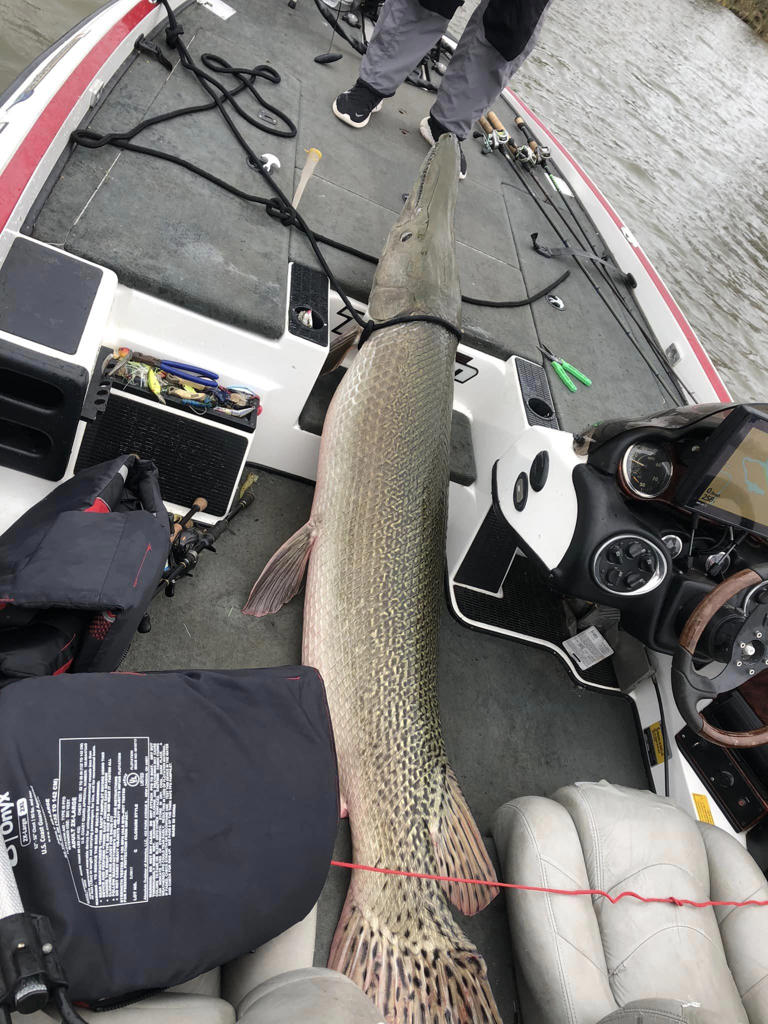
Giant Prehistoric Fish Caught in Alabama Smashes Record

A father and son's huge alligator gar catch in Alabama has been certified as a new state record.
Keith Dees and his son, Huntley were fishing in the Mobile-Tensaw Delta, which feeds into the Gulf of Mexico in the southwestern corner of the state, this past Thanksgiving when they made the record-breaking catch.
The pair have a tradition of going fishing on the holiday and on their latest trip they had already snagged several redfish and largemouth bass. But what happened next surprised both of them with Dees describing the experience as a "day we'll never forget."
"About 11:30 we decided to fish one more spot. I made a cast and about half way back to the boat my chatterbait just went slack," Dees said in a Facebook post. "Reeling as fast as I could, I got it tight just before I saw a big fish swim by my trolling motor. Had no idea what it was until it surfaced after about 30 minutes."
Giant Prehistoric Fish Caught in Alabama Smashes Record

Animal Pictures

Wednesday, January 25, 2023

The Daily Drift

Welcome to today's issue of Carolina Naturally
'Nuff Said!
Today is January 25, 2023
Today is: Library Shelfie Day
On This Day In History
In 1924CE: 1st Winter Olympic Games open in Chamonix, France
Ain't That The Truth
Oh, and while you're at it - check out our sister blog Come What May for off the cuff and off the wall seriousness. Heck, who are we kidding, it's just fun and hilarity.

Editorial Comment

Now we know what is feels like to live beneath a waterfall ... with the incessant waves of heavy rain today it feels like we're looking up through the water to the sky.
It also means that the family pets are acting up - especially the dogs they bark at each and every raindrop.

We do want to give a shout out to our readers in Bulgaria and Pakistan and say thanks for stopping by to read Carolina Naturally.

Remember to have fun and enjoy life.

Editorial Staff

Decorum

Julie d’Aubigny: The Outrageous Life of La Maupin

Julie d’Aubigny was a singer and an expert sword fighter in 17th century France. Her father, who was also an expert swordsman, fought off all of his daughter's suitors until she did an end run around him by hooking up with his boss. D’Aubigny was also bisexual and fell for a young woman whose parents were so scandalized they sent their daughter to a convent. D’Aubigny responded by joining the convent herself and then burning it down to be with her lover. Oh yeah, she was also a married woman who dressed as a man.
This all happened before D’Aubigny turned twenty. As an adult, she became an opera singer known as La Maupin, achieved nationwide fame, and continued her adventures in killing people or sleeping with them. It got to the point where the king of France felt the need to pardon her. Twice. It is astonishing that such shenanigans were tolerated at all in the 1600s, but Julie d’Aubigny was admired by many for her sheer outrageousness. Some envied her, while others just enjoyed the entertainment she provided. And, of course, many were outraged. Read the story of La Maupin at Rejected Princesses.

Rare 1920s Disney character to make first US appearance at Disneyland Resort

A rare cat character from the early days of Disney animation will take a star turn alongside her bunny boyfriend during the upcoming Lunar New Year festival at the Disneyland resort. Ortensia the Cat and Oswald the Rabbit will play starring roles during the Lunar New Year festival running through Feb. 15 at Disney California Adventure. Ortensia and Oswald will make meet-and-greet appearances dressed in Lunar New Year attire in DCA’s Paradise Gardens gazebo — taking turns posing separately for photos and signing autographs during the month-long festival. Ortensia and Oswald are the faces of the Lunar New Year festival at Disney California Adventure that celebrates the Year of the Cat in Vietnam and the Year of the Rabbit in China and South Korea.
Read More

Trend in Tokyo: Renting an Apartment without a Bath

If you're young and broke and living in the city, do you really need a shower? I mean, occasionally, you should take a shower. But do you need an apartment that has its own shower?
Sora News 24 reports that increasing numbers of young residents in Tokyo are deliberately choosing apartments that are so inexpensive that they don't have a shower, then making use of one of the city's declining number of sentos--public bathhouses.
There's a risk involved: sentos aren't open 24 hours a day and the average cost of a single use is about 500 yen ($3.86 USD). But this option is popular enough that there's now a website that specializes in helping people find apartments without baths within a short walking distance of a sento. 

Scientists Have a Genius Plan: Turn Abandoned Mines Into Gravity Batteries

  • Gravity batteries use gravity and regenerative braking to send renewable energy to the grid.
  • Scientists created a battery that uses millions of abandoned mines worldwide (with an estimated 550,000 of them being in the U.S. alone) to store energy.
  • Some companies are trying to build gravity batteries that can be dropped anywhere, regardless of if there are mines in the area.
Supplying the world with renewable energy is a two-fold problem. The first is making technologies like wind and solar as robust and affordable as coal and natural gas. With recent estimates suggesting solar will outpace coal in 2025, that first problem is quickly being solved. The second one, figuring out how to store that energy, is a bit trickier.
Unlike fossil fuels, solar and wind can’t provide an uninterrupted stream of energy. After all, the sun sets and winds die, but scientists and engineers have developed myriad ways to store that renewable energy for when the grid needs it. One idea is to supplement lithium-ion batteries with iron-air batteries that could charge our homes via rust (yes, rust), or transform existing coal-fired power plants into nuclear ones. But another much talked about technology is what’s known as “gravity batteries,” which use regenerative braking and, well, gravity to send energy to the grid.
The big problem is exactly that—they’re big—making them unfeasible (and unattractive) for certain areas. However, earlier this month, scientists revealed a gravity battery that takes advantage of vestiges of dirty energy’s past by using millions of abandoned mines worldwide (with an estimated 550,000 of them being in the U.S. alone) to store energy.
Scientists Have a Genius Plan: Turn Abandoned Mines Into Gravity Batteries

Smile

The Drift

Welcome to today's issue of Carolina Naturally 'Nuff Said! Today is June 21, 2023 Today is:   World Music Day On This Day In History...